The Ordinary Things
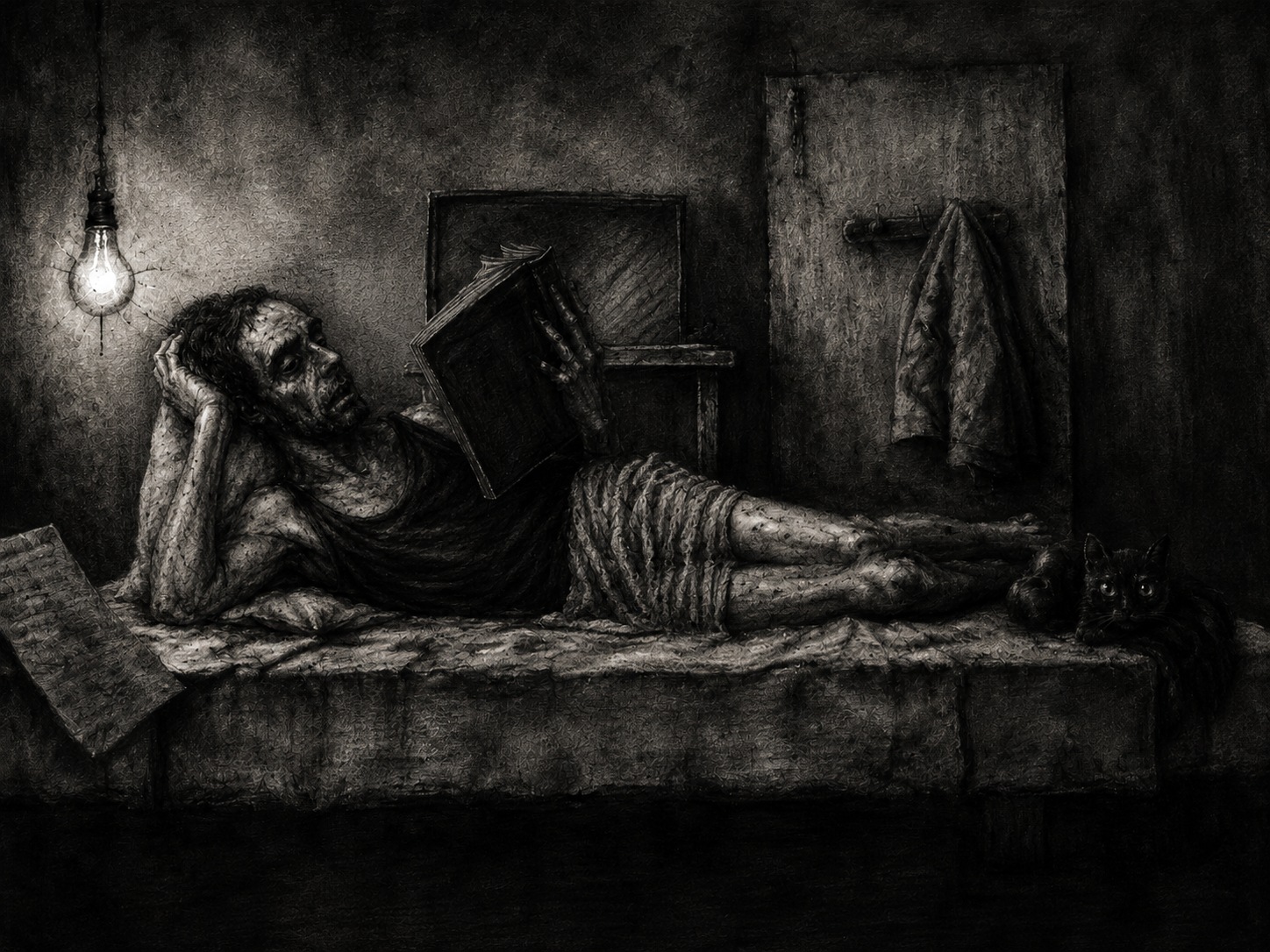
Yesterday’s tea has a smell that knows too much.
Not fresh tea. Fresh tea is hopeful. Fresh tea still believes in morning, civilization, and the possibility that the biscuit will not collapse inside the cup like a corrupt flyover. I mean yesterday’s tea left in the pan overnight, that brown, tannic, faintly metallic smell of dead leaves, milk skin, and municipal regret. It sits there at dawn like a small committee that has examined my life and found the paperwork unsatisfactory.
I wake up with a sour tongue, bad sleep still stuck to my face, and the stomach already making those little drainpipe noises by which middle age announces itself. Nothing grand. No tragic violin. No thunder. Just one 51-year-old Bengali man in the shanty boondocks of South Calcutta, looking at a tea pan as if it has come to collect dues.
The books are there.
The laptop is there.
The phone is there, that pocket-sized slot machine for the spiritually unemployed.
The rough sketches are there too: swollen little faces, criminal potato noses, tax-clerk eyes, tongues like failed public works projects. I look at all this—books, drafts, posts, drawings, dirty utensils, unpaid anxieties—and the thought arrives with its usual bathroom-slipper slap.
This is probably useless.
Not useless like a Roman ruin. A Roman ruin at least has charm. It stands in golden light while tourists make foolish faces in front of it. Not useless like a broken umbrella, which still carries the memory of rain and has, in its crooked way, dignity.
No. I mean useless in the modern algorithmic sense.
That is a special insult. Today even uselessness must dance. It must have lighting. It must jump-cut. It must arrive with lip gloss, background music, and the emotional depth of a plastic spoon. Even nonsense now has to be professionally nonsense. It must shout, wink, wiggle, and say, “Look at me, tired human cattle, I am content.”
My posts do not do that.
They do not jingle.
They do not wear fairy lights.
They do not promise seven habits, five hacks, three secrets, or one monk with a ring light and a sponsorship deal for herbal bathwater.
They are not meretricious. Lovely word, that. It means attractive in a cheap and false way, like a sweet packet that looks festive outside and tastes of cardboard, regret, and industrial ambition. Much of public culture now has this quality. It stands at the digital traffic crossing with rouge on its cheeks, begging the passing thumb for three seconds before the thumb runs off to the next shiny object.
Reality is unpopular.
This is not a complaint. It is closer to a lab result.
Put reality in front of people and they become busy at once. They remember an urgent call. They must check the gas cylinder. They have suddenly developed a deep interest in a reel of a man frying an egg on a motorcycle seat. Not because everyone is stupid. That would be too easy, and also unfair. People are tired. People are overloaded. People have bills, bosses, blood pressure, children, parents, neighbors, algorithms, and the permanent small buzzing of modern dread.
Thinking asks for rent inside the head.
And rent is already high.
The brain is a lazy accountant of glucose. It wants shortcuts. Warm gossip. Easy enemies. Pretty lies. A little outrage in a paper plate. A little humiliation of someone else, served hot. Truth is expensive. It must be chewed. It produces heat. It rearranges the furniture.
Thinking is digestion.
That is why people avoid it. A fact enters, sits in the intestine of the mind, ferments, swells, and suddenly the whole personality must loosen its belt.
Who wants that before breakfast?
Better a slogan.
Better a reel.
Better a patriotic fart in surround sound.
And then there is me.
A bankrupt bipolar Bengali man in the damp outskirts of Calcutta, trying to make a living through small consulting work, some of it paid, some of it floating in that mysterious Indian afterlife called “soon.” I am not a tragic figure. Tragedy needs lighting, chorus, and some ancient Greek fellow standing nearby with a goat. I am more like damp on a wall. Not dramatic. Persistent. Slightly embarrassing. Difficult to explain to guests.
I read books.
I sketch ugly things.
I write these public mutterings, not because Bengal is waiting with garlands, not because the nation will collapse without my paragraph, not because posterity has taken a token and is waiting politely at the counter.
I write because otherwise there is too much time.
Too much room.
Too much silence.
Too much unspent anger walking around inside the ribs like a drunk landlord inspecting his own collapsing building.
Time is not empty.
Empty would be peaceful.
Time is full of me.
That is the problem.
A small room with one middle-aged man in it can become more crowded than Howrah station if the man has memory, shame, unpaid invoices, old desire, ruined prospects, and a brain that refuses to sit down like a trained dog. Every ordinary object becomes a witness. The rice cooker is not a rice cooker. It is a white plastic judge. The tea pan is not a tea pan. It is a forensic vessel. The cracked book is not a cracked book. It is a small rectangular civilization proving that other people, often dead people, found better uses for suffering than staring at their phones and waiting for digestion, payment, or extinction.
Books are indecently patient.
They sit there holding centuries in their lap while I postpone bathing.
A book does not care that I am broke. Euclid does not ask for my bank statement. Darwin, that anxious bearded Victorian who spent years peering at worms and barnacles while quietly removing mankind from the center of creation, does not ask whether my consulting invoice has cleared. Faraday, born poor and apprenticed to a bookbinder, turned invisible forces into practical magic and did not, as far as I know, become a motivational influencer shouting into a wireless microphone in a hotel ballroom.
He is still here anyway.
In the fan.
In the charger.
In the bulb.
In the old wires of the room, humming like a tired insect.
Science is mostly the history of someone noticing the ordinary before the rest of us could monetize it, worship it, or ruin it with a committee.
A falling apple. A swinging lamp. Mold in a dish. Finches with different beaks. A kettle lid jumping because steam wanted a little respect. Ordinary things, almost insultingly ordinary, dragged by attention into explanation.
That is the trick.
Attention.
The world is not short of miracles. It is short of people willing to look at the same boring thing for longer than eight seconds.
And here I am, in my own smaller disgrace, trying to drag my ordinary into language before it drags me under the bed.
My topics are few because my life is narrow. This is not artistic discipline. Let us not put a silk shawl on a goat and call it Tagore. It is geography, bankruptcy, illness, age, and the gradual social disappearance of a man who no longer has market heat.
I have my room.
My mother somewhere in the web of worry.
My bad sleep.
My little meals.
My books.
My memories of another life.
My old technical knowledge, once useful, now fossilized like a trilobite in the mud of employability.
I have the Kolkata air coming in with dust, frying oil, incense, sweat, drain breath, and that special civic perfume of things badly planned by men who spoke very confidently.
People want better topics.
Travel. Success. Investment. Romance. Luxury. Food. Productivity. Gadgets. Gym transformation. Spiritual shortcuts. Five habits of billionaires. Seven lessons from a monk who, after renouncing desire, now owns three microphones and a brand partnership.
I have tea.
I have rice.
I have shame.
I have a window.
I have the astonishing fact that a smell can open a secret door in the head. One moment I am looking at yesterday’s tea. Next moment I am eight years old in an old North Calcutta afternoon, or twenty-three on an aircraft crossing into a future I foolishly believed had handrails, or forty-something back in India discovering that honesty here is often not a virtue but an exposed vein.
Everyone comes to feed.
Client, broker, cousin, official, priest, smooth talker, clever fool, uncle with advice, man with plan, man with plan B, man who says “trust me” and immediately makes trust look like a poultry disease.
Memory is a filthy technology.
We praise it too much. We say memory gives continuity. True. So does a recurring stomach infection if one is determined to see narrative structure in everything. Memory preserves, but it also pickles. It keeps humiliation edible long after its expiry date. It replays a small insult with cinema sound. It turns an unpaid bill into a mythological curse with letterhead.
Still, without memory, what am I?
A man reduced to current symptoms.
A sweating organism with glasses.
A balance sheet with dandruff.
No. The ordinary saved me before I knew the word ordinary. School corridors. Book smell. Chalk dust. Cheap exercise books. A fountain pen leaking blue onto the fingers like private royalty. Tram wires overhead. The metallic taste of fear before exams. Muri eaten from a paper cone. Pressure cookers whistling in the evening from nearby flats, proof that other households were boiling, feeding, arguing, farting, continuing.
That continuing was civilization at street level.
Not flag.
Not anthem.
Not some studio warrior screaming history as if volume were evidence.
Civilization was someone washing a steel plate properly. Someone lending a book. Someone lowering their voice because an old person was asleep. Someone telling the truth when the lie was cheaper. Someone making tea and giving you the better cup.
Ordinary things are not small.
They are small only to people whose imagination has been replaced by packaging.
A cup is archaeology. A bed is politics. A bathroom bucket is class history. A bank form is violence wearing boxes. A cheap notebook is the last republic of a man whose other republics have collapsed.
When I draw grotesque faces, I am not trying to be clever.
I draw what the respectable face hides.
The swollen tongue of greed. The pig eye of certainty. The priestly smirk. The bureaucratic jaw. The intellectual without a spine. The nationalist with a skull full of slogans and a belly full of borrowed masculinity. The entrepreneur of fraud. The respectable uncle whose morality begins exactly where his interests end.
And myself, naturally.
Especially myself.
I am not outside the freak show selling tickets. I am inside, combing my remaining hair, checking whether my own face has become another exhibit: the failed bright boy, the aging loner, the man who once believed in competence, science, clarity, rational systems, and now watches nonsense reproduce like bacteria in warm broth.
Bacteria at least have elegance.
Human nonsense has television lighting.
The posts are probably unpopular because they ask for the one thing the age hates.
Duration.
They ask someone to stay with a thought longer than the lifespan of a mosquito. They ask for a reader, not a consumer. A reader is a different animal. A reader can stop, return, doubt, underline, get irritated, argue. A consumer wants a tube inserted directly into the preference gland.
I write for readers, even if there are six of them and two are bots with better manners than relatives.
But even that is vanity wearing a torn lungi.
The real truth is smaller.
I write because otherwise I begin to fade.
Not romantically. No mist. No pale Bengali ghost with literary cheekbones drifting across the room. I fade administratively. Name not called. Phone not ringing. Inbox dry. Work delayed. Money absent. Body aging. Desire reduced to the occasional humiliating spark behind old plaster. Social identity becomes a cupboard nobody opens.
So I make marks.
Like prisoners on walls.
Like early humans dragging color across cave stone, those magnificent hairy ancestors who had no followers, no analytics, no thumbnail strategy, and still painted animals in the dark because something in the animal called human cannot merely eat, sleep, mate, fear weather, and die. It must leave a sign. It must say: there was a mind here, frightened, hungry, observant, ridiculous, and temporarily upright.
My sign is not grand.
Some days it is only a paragraph about tea.
Some days it is a grotesque sketch of a man with a head like a boiled brinjal and the eyes of a loan defaulter.
Some days it is a note about depression sitting in the throat like poison, not swallowed, not spat out, just lodged there like a tenant who has discovered legal protection.
Some days it is politics, but politics stripped of costume. Politics as drain design, hospital queue, school fee, police indifference, court delay, loudspeaker cruelty, neighborhood cowardice, and the intimate stain where ideology meets daily life.
Some days it is science because science still has the courtesy to say, show me.
Show me the evidence.
Show me the mechanism.
Show me the error.
Not kneel.
Not shout.
Not sell.
Not adjust.
Look.
That is all science asks first. Look carefully, you confused monkey, and do not trust your first story.
This is why I keep going back to it.
Not for comfort. Science is not comforting. Anyone who says science is comforting has not spent enough time with entropy, extinction, cancer, randomness, or the cheerful fact that the universe is mostly empty and utterly indifferent to one’s career. But science is clean in the way a sharp knife is clean. It removes bad explanation. It does not make life kind. It makes some parts of it less foggy.
And the ordinary is where the knife must begin.
Here.
This room.
This bad tea smell.
This body making comic noises.
This old Bengali man with his bankrupt hours and bipolar weather, staring at the day as if it were a creditor standing outside with a clipboard.
I do not know what else to talk about because I no longer live among events. Events belong to people with shoes on. My life arrives in particles. A smell. A memory. A line in a book. A sudden irritation. A sketch. A bill. A crow outside shouting like a municipal clerk. A small desire. A small disgust. A small tenderness that arrives without permission and makes everyone uncomfortable.
Perhaps that is enough.
Not enough to win.
Not enough to trend.
Not enough to be rescued.
But enough to keep the outline from dissolving.
A man is not only his achievements. That is what the achievement merchants never tell you, because if they did, their whole shop would collapse and the motivational posters would fall like wet cardboard. A man is also his noticing. His private inventory. His stubborn catalog of ordinary things. His refusal to let the day pass without at least naming the particular shade of trouble it brought in its little brass bowl.
So I will continue, most likely badly.
Reading.
Sketching.
Writing.
Making tea in the same pan whose brown stains now look like a map of failed empires.
And if nobody reads, then nobody reads. The wall also does not read, but one still behaves decently toward it unless civilization has entirely failed.
The ordinary defined me before I could pronounce the word ordinary. It will probably define me at the end too: one cup, one book left open face down, one ridiculous drawing of a swollen little man with a magnificent head shaped like bad luck, and me beside it, not vanished exactly, just badly printed.